Ruhmkorff electric lamp
A Journey to the Centre of the EarthThe Ruhmkorff electric lamp is the expedition’s portable electric light and one of its essential instruments: powered by a voltaic battery, it illuminates the underground passages where Professor Hardwigg, Harry, and Hans travel. Its first use marks the explorers’ formal entry into the Interior of the Earth, while its design makes light a practical means of proceeding through darkness and even among inflammable gases.
Design and Equipment
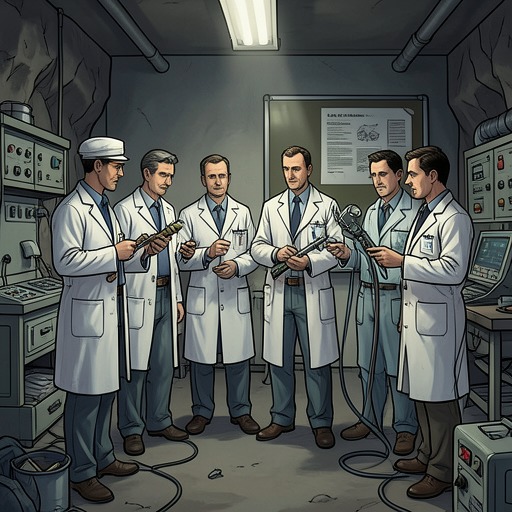
The expedition carries two Ruhmkorff coils, selected as a reliable, portable means of obtaining light. The apparatus works through induced electricity: an inner copper-wire coil is insulated with silk and surrounded by a second, finer insulated coil. When current from a voltaic battery passes through the inner coil, it induces a current in the outer one. In operation, the gas in the lantern becomes luminous and produces a steady white light.
The battery and wire are carried in a leather bag fastened to the traveler’s shoulders; the lantern is positioned in front. This arrangement makes the light wearable rather than fixed in place, leaving the explorer able to move with it. The equipment list’s two coils and a voltaic battery therefore describe a working system, not merely a source of illumination: current, carrying apparatus, and lantern together supply light on the move.
The accompanying explanation emphasizes the lamp’s unusual range of use. It can be carried into profound obscurity, into the midst of highly inflammable gases without fear of explosion, and beneath deep water. These properties suit an expedition whose route cannot be assumed to remain open, dry, or safe. The lamp is presented as dependable equipment for conditions in which ordinary daylight and conventional expectations of a lit path no longer apply.
First Use Underground
Before the explorers set out, Professor Hardwigg organizes their instruments and records the expedition in his notebook. On June 29, at 8:17 in the morning, he declares that their travels truly commence as they take their first step into the Interior of the Earth. As he speaks, he holds the Ruhmkorff coil apparatus around his neck and connects the electric current to the lantern’s mechanism. Light immediately fills the dark tunnel.
Hans carries the second apparatus and switches it on as well. With both lamps working, the party can proceed by what the narrator describes as the light of an artificial day, even amid the flow of the most inflammable and combustible gases. Hans leads, Professor Hardwigg follows, and Harry comes third. The lighting thus establishes the order and movement of the group as they enter the passage; it gives their descent a practical means of continuation rather than leaving it at the threshold.
The moment also places the lamp between two kinds of darkness. The party has descended through the volcanic shaft from the open Iceland sky, and Harry looks up at that sky as they enter the gloomy gallery, knowing he will never see it again. The electric light does not restore the world they have left behind; it enables them to advance into its opposite. Its brightness turns the tunnel into a traversable space while underscoring how far the explorers have moved from daylight above.
Function and Significance
The lamp’s role is material and immediate: it provides the light by which the expedition can move through an underground passage, and its stated resistance to explosive gases addresses a danger posed by the environment. It is part of a broader package of instruments prepared for the descent, but unlike the measuring devices, its function is visible as soon as the current is connected. The tunnel changes at once from a dark obstacle into a route the party can enter.
That transformation does not make the journey secure or dispel its uncertainty. The narrator sees the illuminated entrance as the beginning of a passage into an unknown world, not as proof that the explorers can control what lies ahead. The light makes movement possible while leaving the underground itself unfamiliar. In this way, the lamp’s practical success sharpens rather than resolves the contrast between human ingenuity and the scale of the place being explored.
The lamp also gives the expedition’s claim to enter a previously unvisited world a concrete form. Professor Hardwigg announces the beginning of their travels, and the device answers with artificial illumination; the declaration becomes an action because the explorers can now step forward together. The portable light is therefore not just an accessory carried below ground. It is the enabling instrument at the expedition’s first decisive threshold, making darkness navigable without making it familiar.